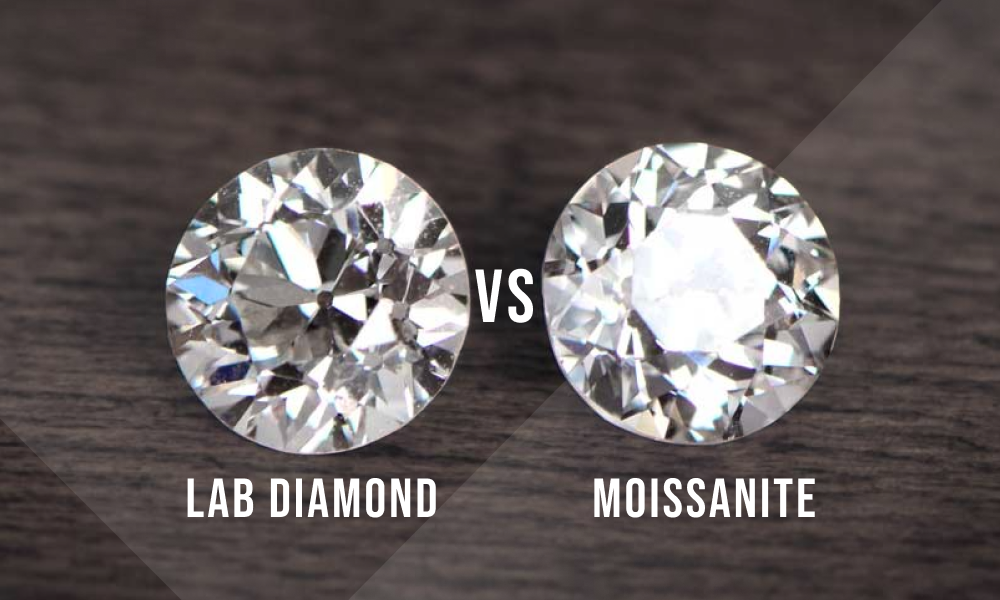


There are so many diamond alternatives and diamond simulants available on the market - which one will you choose? Moissanite vs cubic zirconia vs diamond - which is the best selection for your next purchase?And in the cubic zirconia vs diamond debate specifically, which one delivers the better visual result for your budget?
Diamond is the hardest and most valuable of the three stones, made of pure carbon with a 10/10 Mohs hardness. Moissanite (silicon carbide, 9.25 Mohs) is the most brilliant and a popular diamond alternative. Cubic zirconia (zirconium dioxide, 8-8.5 Mohs) is the least expensive but also the least durable.
This blog post will cover moissanite vs. diamond vs. cubic zirconia, focusing on their unique properties and attributes.
What you decide to purchase says something about you–choosing a stone is a personal preference that should be rewarding and fun.
Moissanite vs Diamond vs Cubic Zirconia: Side-by-Side
Here is a complete side-by-side comparison of the three stones across every attribute that matters to buyers. This is the single most useful reference on the page — bookmark it.
The takeaway: for a stone that looks like a diamond and lasts a lifetime, moissanite is the strongest value pick. For an heirloom-grade investment, diamond is unmatched. For affordable fashion jewelry that does not need to last forever, cubic zirconia is the most accessible choice.
Get the Best Deals on Moissanite Jewelry from IceCartel™ Today!
The History and Origin
The following section breaks down the history and origins of diamond vs moissanite vs cubic zirconia.
Moissanite

In 1893, Nobel Prize-winning chemist Dr. Henri Moissan discovered natural moissanite in Arizona in the earth’s mantle. Natural moissanite is a very rare mineral, rarer than diamonds and other precious colored stones! Natural moissanite is found in small quantities in certain rocks, including meteorites, kimberlites, and lamproites.
Because it is so rare, scientists wanted to find a way to mimic it in a lab, making its show-stopping beauty available to the world. Gem-quality moissanite was first introduced by Charles Eric Hunter in the 1990s, who formed the company Charles & Colvard Ltd. Moissanite was patented in the US in North Carolina.
Diamond

According to the Gemological Institute of America (GIA), diamonds form deep in the earth under extreme heat and pressure. The diamond is then ejected to the earth's surface, found by force of nature or by laborers. Diamonds go through a cleaving, cutting, and polishing process.
Diamond's popularity started in India as early as the 4th century BC when diamonds were gathered from bodies of water. Soon diamonds found their way to Western Europe in the caravans traveling to Venice’s medieval markets. By the 1400s, diamonds became synonymous with Europe’s elite. India's diamond supply started declining in the 1700s. Brazil became an important diamond source dominating the market for over 150 years, discovered by pans of gold miners sifting through gravels of local rivers.
Diamonds went through many upheavals throughout the centuries as they became more available to the masses. New sources of diamonds were discovered, including in Africa, making them more widespread and available. Today, technology has allowed scientists to uncover more locations for diamonds efficiently.
Cubic Zirconia
Did you know that cubic zirconia is actually a natural stone? In 1937, German mineralogists M. V. Stackelberg and K. Chudoba discovered naturally occurring cubic zirconia in the form of microscopic grains included in metamict zircon.
Synthetic cubic zirconia was originally created for use in lasers and optical applications. Synthetic cubic zirconia's production grew over time, exceeding other earlier synthetic diamond simulants, including strontium titanate, YAG (yttrium aluminum garnet), and GGG (gadolinium gallium garnet).
Today, lab-created cubic zirconia (“cubic zirconia”) remains incredibly popular, often set into alloy metals or fine metals, utilized in both the fashion jewelry and fine jewelry category. Cubic zirconia is available in different colors, making it versatile.
For more information on cubic zirconia vs moissanite, make sure to check out our blog, Shining The Light On Cubic Zirconia Vs. Moissanite: Which Is The Better Gemstone?
Physical Properties and Characteristics

The following will break down the physical properties and characteristics for
moissanite vs cz vs diamond:
Moissanite
Moissanite is composed of silicon carbide (SiC), with a carbon atom surrounded by four silicon atoms in a tetrahedral form.
The refractive index (fire) measures the bending of a ray of light when passing from one medium into another (Britannica). Moissanite’s stunning fire is due to its high refractive index of 2.65 to 2.69, with noticeable double refractivity and an adamantine luster.
Moissanite exhibits its trademark “disco ball effect” as the stone moves with a gorgeous rainbow of color. The “doubling” of the stone can easily be seen under 10x magnification. Did you know moissanite is known as the most brilliant stone on earth? Moissanite is more brilliant than a natural diamond, lab-created diamond or cubic zirconia.
Moissanite has a specific gravity (“SG” density) of 3.22, making it a dense mineral.
Diamond
Diamond is known for its fire (refractive index), scintillation (sparkle, emitting flashes of light from the facets and surface) and brilliance, or the white light the stone reflects. Diamond has a refractive index of 2.418 with an adamantine luster.
Diamond is made up of a single element, carbon. Diamond has a cubic crystal system and an octahedral crystal habit. It has a specific gravity of 3.52, making it heavier than moissanite but not as heavy as cubic zirconia.
Cubic Zirconia
Cubic zirconia (abbreviated CZ) is the cubic crystalline form of zirconium dioxide (ZrO2). Cubic zirconia has a refractive index of 2.15-2.18 with a specific gravity of 5.6-6.0 g/cm3, making it dense.
Durability

Gems and mineral hardness or the "ability to be scratched" is measured on the Mohs scale, helping identify the mineral and its scratch-resistant tendencies. Moissanite rates 9.25 out of 10 on the Mohs scale of hardness, making it durable and hard.
Diamond rates a 10/10 on the Mohs scale of hardness, making it the most scratch resistant mineral on earth.
Cubic zirconia has a 8-8.50 rating on the Mohs scale of hardness, making it great for wearing frequently. However, cubic zirconia for its abrasion, or wearing out around the facet junctions, showing noticeable chipping.
Cost and Value for Money
The following is a breakdown of the cost and value of cubic zirconia vs diamond vs moissanite:
Moissanite: Moissanite is significantly less expensive than a diamond, but more expensive than a cubic zirconia. Moissanite is a high-quality diamond alternative that may be accompanied by a certification for insurance purposes. Insuring your moissanite rings and pendants is a great choice. If you want something unique, check out our Custom Moissanite Jewelry collection for bespoke designs.
- Value: Although it is not as pricey as a natural diamond, moissanite still does have some resale value. Moissanite is a high-quality diamond alternative for those who seek a sustainable, eco-friendly gemstone in place of a diamond.
Diamond: Diamonds are the most valuable of these three stones. They're also the traditional choice for engagement rings and other fine jewelry, known as the world's most precious stone.
They are not as affordable as moissanite or cubic zirconia, making them investment purchases.
- Value: Diamonds are valuable for those who want high-quality jewelry that holds its value over time. The cost of a diamond varies greatly depending on the 4 Cs (carat weight, cut, clarity, and color). Moissanite is also graded according to the 4Cs.
Cubic Zirconia: Cubic zirconia is much less expensive in comparison to the stones of the same carat and size of diamonds and moissanite.
- Value: Cubic zirconia is an affordable option for those who love fashion-forward trends.
Eco-Friendliness and Ethical Considerations
Moissanite, cubic zirconia, and natural, earth-mined diamonds are all popular choices for jewelry, featuring environmental and ethical considerations.
Moissanite and CZ are lab-created stones that do not involve any mining. Moissanite and CZ are not associated with any human rights abuses or conflicts.
Diamonds are associated with environmental and ethical concerns. Diamond mining impacts the environment, including soil erosion, deforestation, and water pollution. Additionally, there have been reports of human rights abuses in the diamond industry, including forced labor. Conflict-free diamonds are a way to absolve these concerns. However, conflict-free may not always be verified.
Is Moissanite a Diamond?
No, moissanite is not a diamond. Moissanite is a completely separate gemstone made of silicon carbide (SiC), while diamond is pure carbon. The two stones look similar to the naked eye because both are colorless, brilliant, and durable. But they are different minerals with different chemical compositions, refractive indexes, and prices.
The confusion comes from how moissanite is marketed. Many jewelers sell moissanite as a "moissanite diamond" because it looks like a diamond, passes most thermal diamond testers, and works in the same engagement-ring settings. Calling moissanite a "diamond" is technically incorrect. The stone is a high-quality diamond alternative, not a diamond itself. Lab-grown diamonds are real diamonds. Moissanite is not.
If you are wondering whether a stone you own is moissanite or a real diamond, the easiest test is a dual thermal-and-electrical conductivity tester. Moissanite conducts both heat and electricity; diamond only conducts heat. A dual tester will identify the difference within seconds.
Is Cubic Zirconia a Diamond?
No, cubic zirconia is not a diamond. Cubic zirconia (CZ) is a synthetic gemstone made of zirconium dioxide (ZrO₂), while diamond is pure carbon. CZ is the most affordable diamond simulant on the market and looks visually similar to diamond, but the two are completely different minerals. CZ is softer (8 to 8.5 on the Mohs scale vs. diamond’s 10) and has a lower refractive index, which means it does not sparkle quite the same way under light.
To anyone untrained, a CZ stone looks like a diamond at first glance. Side-by-side and under magnification, the differences become obvious, CZ has too-perfect clarity (real diamonds have natural inclusions), a slightly different sparkle pattern, and the stone will fail a standard diamond tester immediately. CZ is best understood as costume-grade jewelry: beautiful, accessible, but not built to last decades the way a diamond or moissanite is.
Maintenance and Care

Cleaning your moissanite, diamond, and cubic zirconia jewelry every 2-3 weeks is recommended. Regularly maintaining your jewelry will remove bacteria, debris, and build-up caused by exposure from everyday cleaning products, cosmetics, and more.
Using the warm soapy water method is the easiest way to keep your jewelry clean:
- Fill a bowl with lukewarm tap water. Mixing this solution with soap will create suds.
- Marie Claire online suggests using Dawn dish soap.
- Place your moissanite ring, diamond, or cubic zirconia jewelry in the soapy water bowl, letting it soak for 10-15 minutes. This allows the build-up to loosen around the stone, its settings, and other parts.
- Gently scrubbing with a NEW brush removes these dirt particles.
- Please Note: using excessive force is never required–this may damage delicate design parts.
- Rinse the ring thoroughly under cool water running from the tap, removing the soapy residue. Pat dry with a soft, lint-free cloth, or let it air dry.
Tips: Removing your moissanite, diamond, and cubic zirconia jewelry before swimming in chlorine, saltwater, and bathing will keep it from damage or loss. Storing your jewelry in a box, bag, or drawer prevents loss, damage, and exposure to environmental factors.
Make sure to check out our in-depth blog, How to Clean Moissanite Ring: 7 Tips to Keep Moissanite Brilliant for more information.
Final Thoughts
When it comes to cz vs moissanite vs diamond, which is best for you?
Cubic zirconia and moissanite are affordable diamond alternatives that are budget-friendly, beautiful, and perfect for those who love all the sparkle and fire of a diamond without the strenuous work supply and marked-up price points.
Moissanite is a high-quality diamond alternative with unique attributes made to withstand a lifetime of wear. Feel good shopping for moissanite earrings, rings, pendants, and more knowing you are receiving a long-term design made to withstand a lifetime.
Moissanite is a durable stone, although not as durable as diamond. Cubic zirconia is less durable, known for abrasion and chipping.
Diamond will always remain the most sought-after precious gemstone, unparalleled in prestige and synonymous with luxury. However, this does not mean alternatives are “less than.” Modern diamond simulants like moissanite and cubic zirconia offer endless designs in the size you want for a fraction of the cost.
Frequently Asked Questions
Which is better: moissanite, diamond, or cubic zirconia?
The best choice depends on your budget and how long you want the stone to last. Diamond is best if you want an heirloom-grade stone that holds value over generations, it is the hardest and most expensive of the three. Moissanite is best for buyers who want a diamond-like look at roughly 10 percent of the price while still having a lifetime-durable stone. Cubic zirconia is best for fashion jewelry where cost matters more than longevity.
How much cheaper is moissanite than diamond?
Moissanite typically costs 80 to 90 percent less than a natural diamond of the same size and quality. A 1-carat moissanite usually runs $200 to $600, while a 1-carat natural diamond can run $4,000 to $7,000 or more. Lab-grown diamonds sit in between, usually $1,000 to $2,000 for a 1-carat stone.
How much cheaper is cubic zirconia than diamond?
Cubic zirconia typically costs 99 percent less than a natural diamond. A 1-carat cubic zirconia stone usually runs $20 to $100, while a 1-carat natural diamond runs $4,000 to $7,000 or more. The dramatic price gap reflects that CZ is mass-produced and not built to last decades.
Will a moissanite or cubic zirconia pass a diamond tester?
Moissanite passes a standard thermal diamond tester because it conducts heat at almost the same rate as a real diamond. Cubic zirconia does NOT pass a thermal diamond tester, it fails immediately because zirconium dioxide has very different thermal properties.
Can a jeweler tell the difference between moissanite, diamond, and cubic zirconia?
Yes, every time. A trained jeweler can identify all three stones within seconds using a 10x loupe. Moissanite shows double refraction (facet edges appear to double) and an unusually rainbow-colored fire. Diamond shows single refraction and an icy-white sparkle. Cubic zirconia has too-perfect clarity (real diamonds have natural inclusions) and a slightly softer luster.
Is moissanite a "fake" diamond?
No. Moissanite is not a "fake" anything; it is a separate, real gemstone with its own chemistry, name, and value. It is sometimes marketed as a "diamond simulant" or "diamond alternative" because it visually resembles diamond, but those terms describe its market position, not its nature. Moissanite has been a recognized gemstone since 1893 (discovered by Nobel laureate Henri Moissan) and is graded on the same 4Cs scale as diamond.